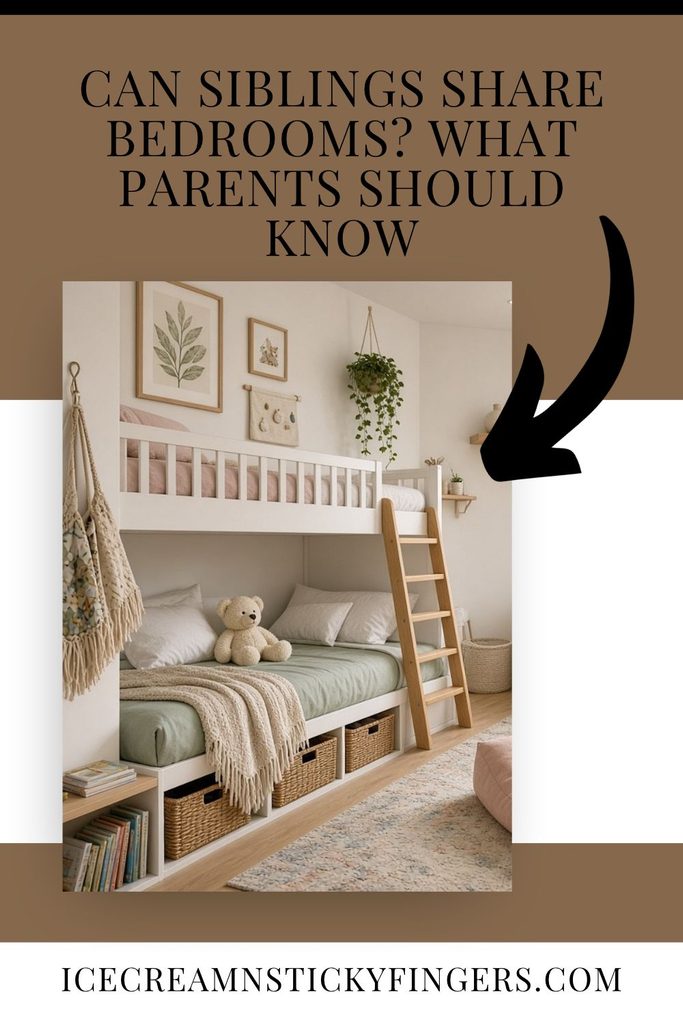
Can Siblings Share Bedrooms? What Parents Should Know
The question of can siblings share bedrooms usually comes up when a family is outgrowing a home, welcoming a new baby, moving, or simply trying to make the bedrooms work better. And while sharing a room can bring plenty of sweet sibling memories, it can also bring bedtime giggles, arguments over whose stuff is whose, and one child waking up everybody else at 6 a.m.

Photo Credit: Pixabay
The good news is that siblings can absolutely share a bedroom. Whether it is a good fit for your family depends less on having a picture-perfect room and more on your children’s ages, temperaments, sleep needs, and the routines you put in place. Let’s take a look at can siblings share bedrooms.
Can Siblings Share Bedrooms Successfully?
Yes, many siblings share bedrooms happily for years. In a practical sense, room sharing can free up a bedroom for a nursery, home office, playroom, or visiting family. For children, it may also build closeness, cooperation, and the ability to consider another person’s needs.
But sharing a room is not automatically cozy just because the kids are related. A toddler who wakes before sunrise and an elementary-aged child who needs solid sleep for school may struggle in the same space. So might one child who craves quiet and another who talks, sings, and plays until the last possible second.
There is no universal age when siblings must have separate bedrooms in most American homes. Families make this decision based on space, culture, finances, privacy, and what helps everyone function. The real question is not whether sharing is always good or bad. It is whether your current setup gives each child enough rest, safety, privacy, and a sense that they belong in the room.
When Sharing a Bedroom Makes Sense
A shared bedroom often works best when children have somewhat compatible schedules. Two young siblings who both go to bed around the same time may adjust more easily than a preschooler and a middle schooler. Siblings who enjoy being together, even if they still argue as siblings do, may also see the room as a comfort rather than a punishment.
It can be especially helpful during transitions. A child who is nervous about sleeping alone may settle more easily with a sibling nearby. Twins often enjoy the familiarity of sharing a space, particularly when they are young. And if your home is tight on bedrooms, sharing can be a reasonable, loving solution rather than something to feel guilty about.
The room itself matters, too. You do not need a giant bedroom, but children need a safe sleep space and a reliable place for their belongings. If every bedtime requires moving piles of toys, stepping over clothes, and negotiating who gets the only clear patch of floor, the setup needs a reset.
Signs Your Kids May Need More Space
Most sibling squabbles do not mean it is time to rearrange the entire house. Still, repeated problems can tell you that the room-sharing arrangement needs changes or may no longer be working.
Pay attention if sleep is consistently disrupted, not just during an occasional rough week. One child may be waking the other, talking after lights out, using a night-light that keeps the other awake, or getting up early and making it impossible for their sibling to sleep. Chronic tiredness affects moods, school, and family peace quickly.
Privacy becomes more important as kids get older. A child may need somewhere to change clothes, calm down, journal, talk privately with a friend, or simply be alone for a few minutes. That does not always require a separate room, but it does require respect and some creative planning.
You may also need to reconsider if conflicts become constant and personal. There is a difference between arguing over a stuffed animal and one child feeling pushed out of their own room. If one sibling controls the space, destroys belongings, bullies the other, or refuses to honor boundaries, address that behavior directly instead of expecting the room arrangement to fix itself.
How to Set Up a Shared Bedroom That Feels Fair
The goal is not to make both sides of the room identical. Kids have different interests, colors, collections, and comfort items. The goal is to make sure each child has a clear place that feels like theirs.
Start by giving each child a defined sleep zone. This might mean separate beds on opposite walls, bunk beds with personal reading lights, or a small divider between beds. A bookshelf, curtain, cube organizer, or even a carefully placed dresser can create visual separation without a major renovation. Make sure any furniture used as a divider is anchored safely.
Each child should have dedicated storage, too. Separate drawers, bins, hooks, and shelf space reduce many of the little arguments that make parents feel like referees. Labeling bins can help younger children, while older kids may prefer choosing their own organization system.
Let each child add a little personality. One may want dinosaur bedding while the other prefers flowers or sports. That is okay. A shared bedroom does not have to match from wall to wall to look put together. Coordinating a few basics, such as wall color or furniture, while allowing individual bedding and decor usually feels more fair than insisting everything be the same.

Photo Credit: Pixabay
Make Bedtime Rules Before You Need Them
Bedtime is where a shared room either starts to work or falls apart. The rules do not need to be harsh, but they do need to be clear enough that you are not reinventing them every night.
Decide what happens after pajamas are on. Maybe both kids choose one quiet activity, then lights go out at the same time. If one child needs a later bedtime, let that child read quietly in another room until it is time to sleep. If one child wakes much earlier, set out clothes and a quiet morning activity somewhere outside the bedroom so they can get up without waking their sibling.
It also helps to teach a simple distinction: shared room does not mean shared everything. Children should ask before borrowing, respect each other’s bed and special belongings, and avoid touching things that have been placed in a sibling’s designated area. Younger kids will need reminders, of course. Consistency matters more than expecting instant maturity.
When conflict happens, avoid treating the room as the problem every time. Help children name what went wrong: Was someone too loud? Did somebody take something without asking? Was one child trying to sleep while the other wanted to play? Specific problems have specific solutions, and that teaches better skills than simply saying, “Stop fighting.”
Different Ages and Different-Gender Siblings
Age gaps deserve some extra thought. A baby or toddler can share with an older sibling if sleep routines are manageable and the room is safely arranged. That may mean keeping small toys, cords, and climbable furniture away from a curious little one. It may also mean accepting that the arrangement is temporary while the baby’s sleep changes every few months.
With a bigger age gap, protect the older child’s need for school-night sleep, homework time, and personal belongings. A seven-year-old may adore a toddler sibling but still need breaks from toddler noise and bedtime chaos.
Different-gender siblings can share a room when they are young, and many families do so comfortably. As children approach puberty, privacy needs often increase. Pay attention to your child rather than waiting for a magic birthday. A room divider, changing clothes in the bathroom, individual storage, and regular conversations can help for a while, but some families eventually decide separate rooms make the most sense if space allows.
Give Kids a Voice, Not the Final Vote
If you are planning a shared room, talk with your children before moving beds and bins. Explain why the change is happening in simple, reassuring terms. Let them help choose bedding, decide where furniture goes, or pick a shared room rule. Having a small amount of control can make a big transition feel less scary.
At the same time, parents are allowed to make a practical call. You may not have another bedroom available right now, and that is not a parenting failure. Listen to concerns, take sleep and safety seriously, and adjust what you can.
A shared bedroom does not need to look like a catalog photo to serve your family well. If your children are rested, feel respected, and have a little room to be themselves, you are creating something much more useful: a home that works for the season you are in.