How to Teach Sharing Skills Without Forcing It
The toy your child has ignored for three weeks suddenly becomes the most precious thing in the house the second a friend picks it up. If you are wondering how to teach sharing skills without turning every playdate into a negotiation, you are not alone. Sharing is a big social skill for little kids, and it takes more practice than most adults realize.

The goal is not to make your child hand over every item on command. The real goal is to help them learn that other people have needs, that waiting can be hard but manageable, and that they can protect their own feelings and belongings, too. Those lessons build empathy, patience, and confidence over time. Let’s take a look at how to teach sharing skills without forcing it.
Why Sharing is Hard for Young Children
Toddlers and preschoolers are still learning that other people have thoughts and feelings separate from their own. They also do not have much practice with self-control yet. When a child grabs a truck, hugs a stuffed animal tightly, or yells, “Mine!” they are usually not being selfish on purpose. They are communicating a very real feeling with the tools they have.
Development matters here. A 2-year-old may be able to practice taking turns for a few seconds with lots of help, while a 5-year-old may manage a timer and a simple agreement with a friend. Older elementary-age children may understand fairness but still struggle when a sibling gets something they wanted.
That is why forcing a child to give up a toy immediately can backfire. They may comply in the moment, but they do not necessarily learn generosity. More often, they learn that adults cannot be trusted to help them hold a boundary. A calmer approach teaches both kindness and ownership.
How to Teach Sharing Skills Through Everyday Routines
Start with the language you use at home. Instead of saying, “You have to share,” try naming what is happening and offering a clear next step: “You are using the blue marker. Your sister wants a turn when you are done.” This tells both children that you see them.
Turn-taking is often easier for young children to understand than sharing. One child does not have to give something away forever. They only need to wait for a turn. A kitchen timer, a favorite song, or counting to ten can make that wait feel concrete. You might say, “When the timer beeps, it is Maya’s turn with the scooter. Then you can have it back.”
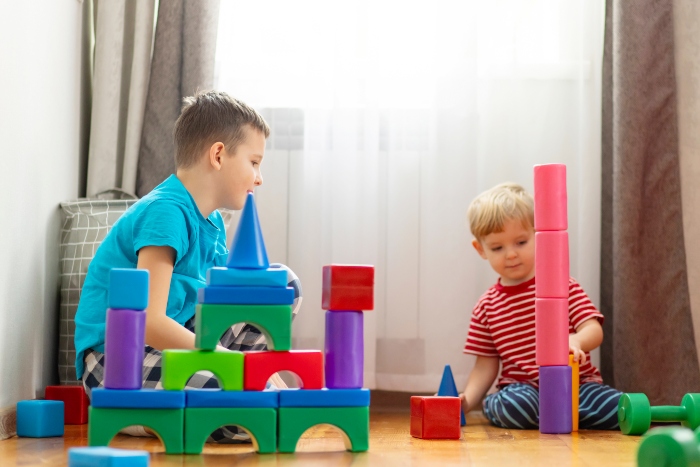
It also helps to practice when no one is upset. During a snack, pass crackers around and say, “I take one, then you take one.” While building with blocks, take turns adding a piece. Board games, rolling a ball back and forth, and simple baking jobs all give children low-pressure chances to wait, watch, and participate.
Give Children Words They Can Use
Kids are more likely to grab when they do not know what else to say. Offer short phrases they can remember in the heat of the moment. Practice them casually at home, almost like a game.
A child can say, “Can I have a turn when you are done?” They can also say, “I am still using that,” or “You can have it after two more minutes.” If another child reaches for something, teach your child to say, “Please ask me first.”
These phrases matter because sharing should not mean ignoring consent or personal space. Your child is allowed to be uncomfortable when someone grabs their belongings. They can learn to be kind without learning that they must always give in.
Prepare for Playdates Before the Doorbell Rings
A little preparation can prevent a lot of tears. Before a friend comes over, walk through the play area with your child. Ask if there are a few special toys they would rather put away. This is not encouraging possessiveness. It is a reasonable way to help a child feel secure in their own home.
You can say, “Your friend will have lots of toys to play with. Are there any you want to keep in your room today because they are extra special?” Let them choose a few, then put them away without judgment.
Next, set a simple expectation: “Friends take turns. If you need help, come get me instead of grabbing.” Keep it brief. Long lectures right before company arrives usually disappear the moment someone rings the bell.
For toddlers, it can be smart to bring out duplicates when possible. Two dump trucks will not teach every sharing lesson, but they can save a playdate from becoming a 45-minute battle over one wheel. There is no prize for making things harder than they need to be.
Step in Early When Emotions Rise
When children are upset, they need a calm adult more than a speech about manners. Move close, get low, and describe the problem without assigning blame. “You both want the red shovel. That is hard.” Then hold the boundary: “I will not let you grab it from him.”
From there, offer a workable plan. “Ella has it now. You can use the yellow shovel while we wait, or we can set the timer for two minutes.” If the child with the toy is done, you can encourage a handoff: “Are you ready to give Noah a turn, or do you need one more minute?”
Sometimes a child will be too overwhelmed to cooperate. That does not mean the lesson failed. Help them reset with a drink of water, a quiet spot, or a different activity. A child who is hungry, tired, overstimulated, or already frustrated will have a much harder time waiting.
Avoid Labeling Your Child
Try to skip labels like “selfish,” “bossy,” or “bad sharer.” Kids tend to live up to the identities they hear most often. Focus on the behavior instead: “You were not ready to give up the doll,” or “You grabbed because you wanted a turn.”
Then point out progress when you see it. “You waited while your brother finished his turn. That was tough, and you did it.” Specific praise teaches children which behavior to repeat without making them feel like they must perform generosity for adult approval.
Model the Kind of Sharing You Want to See
Children notice how adults handle limited resources. Let them hear you take turns with another grown-up, offer the last cookie, or ask before borrowing something. You can narrate it simply: “I would like to use Dad’s charger, so I am going to ask first.”
Sibling conflicts are another chance to model fairness, even when you are tired of hearing about the same toy for the tenth time. Fair does not always mean identical. One child may get more time with an item because they had it first. Another may need a different choice because they are younger or because the activity has a clear age limit.
Explain the decision in plain language. “Your brother was building with those pieces first, so he gets to finish his tower. You can choose the magnet tiles or wait for a turn.” Clear, steady boundaries feel more fair to children than changing the rules to stop every complaint.
When Should You Expect Independent Sharing?
There is no magic age when kids suddenly become gracious little hosts. Some children are naturally more flexible, while others need more time, especially during transitions, growth spurts, or stressful family seasons. Temperament plays a role, and so does how often a child has chances to practice with peers.
What you can look for is gradual growth. Your toddler may move from grabbing to protesting with words. Your preschooler may tolerate a short timer. Your school-age child may begin offering a turn without being asked. Those are meaningful wins.
If your child consistently becomes extremely distressed around possessions, hurts others during conflicts, or cannot manage any turn-taking despite patient practice, it may help to talk with their pediatrician or a child development professional. Most sharing struggles are a normal part of growing up, but support is always available when family life feels stuck.
Teaching sharing is less about producing a perfectly polite child and more about giving your child a repeatable path through a hard moment: name the feeling, ask for a turn, wait with support, and try again. That kind of practice may look messy now, but it is the everyday work that helps children become thoughtful friends, siblings, and teammates later. Use this guide on how to teach sharing skills to your children and implement a plan that works for your family.